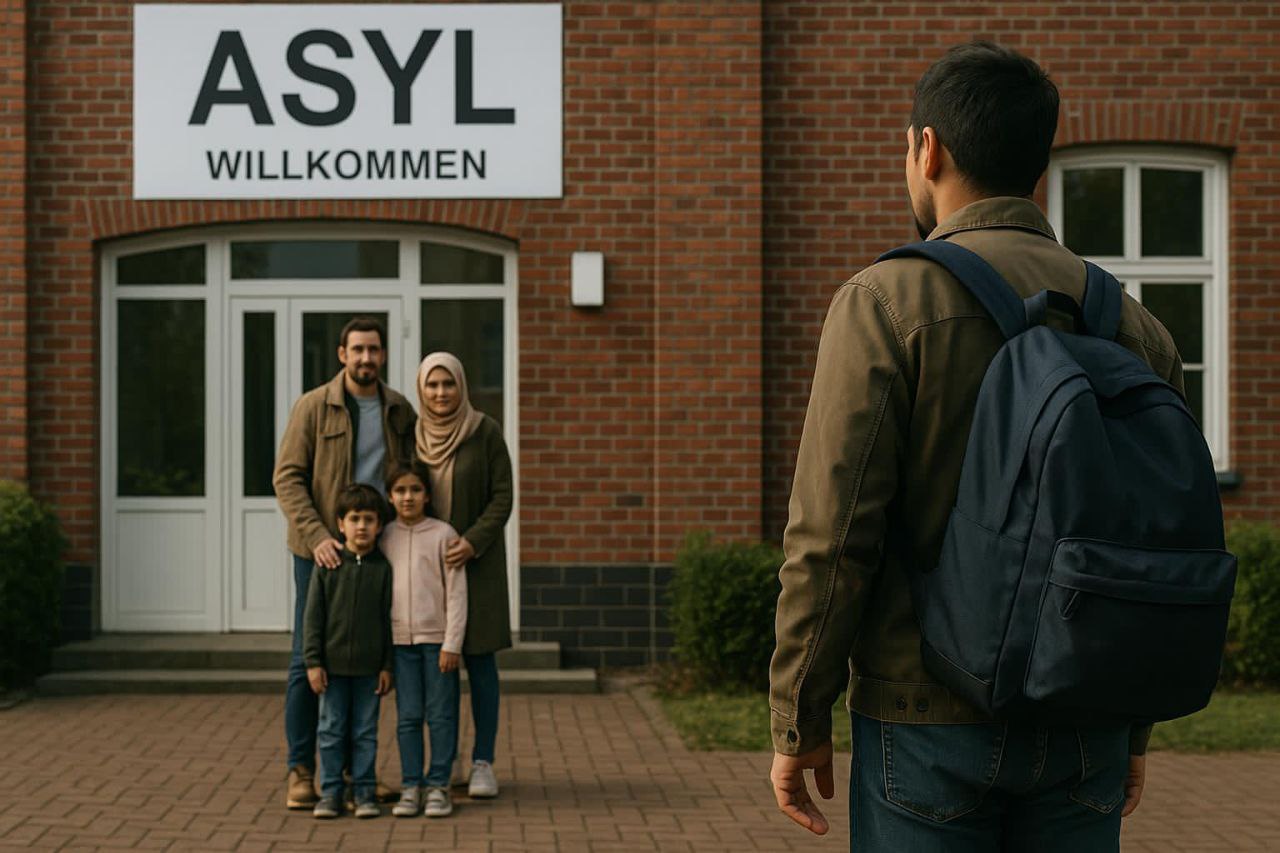
Comprehensive comparison between the asylum pathways in Germany and France
(Application procedure – financial support – work – family reunification – path to citizenship)
| Germany | France | Item |
|---|---|---|
| Reception centre (ANKER) within 48 hours, then transfer to BAMF. Average decision time 8.7 months in 2024–2025 (tagesschau.de). | GUDA appointment within 3 days, OFPRA file to be submitted within 21 days. Average processing time 138 days (≈ 4.5 months) in 2024 (ofpra.gouv.fr). | Registration of the claim |
| €441 per month per person (from 1 January 2025) (BMAS.de). | €14.20 per day if no accommodation is provided (≈ €432/month) (service-public.fr). | Asylum-seeker allowance |
| Initial work ban of 3 months; extended to 6 months for those who remain in the reception centre. After that, a permit from the foreigners’ authority is required (BMAS.de). | Work authorisation can be requested after 6 months if OFPRA has not yet taken a decision; it is granted for a specific fixed-term job offer (service-public.fr). | Right to work during the procedure |
| Residence permit for 3 years, renewable; work not restricted (BAMF). | Ten-year resident card for refugees, or a 4-year card for subsidiary protection (ofpra.gouv.fr). | Residence card after recognition |
| For refugees: spouse/children without income requirement if the request is filed within 3 months. For subsidiary protection: cap of 1,000 visas per month, which may be suspended in 2025–2026 (help.unhcr.org). | Open to both refugees and subsidiary protection holders without resource or numerical limits, via the OFII–OFPRA family reunification track (ofpra.gouv.fr). | Family reunification |
| 600 hours of language course + 100 hours of civic orientation, fully funded (BAMF, BAMF). | Up to 600 hours of French funded by OFII; mandatory “integration contract” in the first year. | Language support / integration |
| After 5 years with B1 language level and stable income (BAMF). | After 5 years for subsidiary protection; refugees already hold a 10-year card. | Permanent residence |
| Naturalisation after 5 years (or 3 with exceptional integration) under the law of 27 June 2024; dual citizenship allowed (Deutschland.info). | A refugee can apply for naturalisation “without a minimum residence period” under Article 21-19 of the Civil Code; in practice, cases are decided after 18–24 months (France terre d’asile). | Citizenship |
1. Ease of application and speed of decision
In terms of timing, France has the advantage: an average of four and a half months and a single stop (GUDA) where fingerprints and the initial interview are handled together.
Germany introduced ANKER centres to bundle the steps, but the build-up of cases has pushed the average up to 8.7 months – the longest duration since 2017.
2. Financial support and reception conditions
Cash amounts are relatively similar, but Germany provides statutory health insurance from the moment of registration, whereas higher levels of the French ADA depend on the absence or refusal of state-provided accommodation.
In Germany the mix of cash and in-kind benefits varies between federal states; in France payments are loaded weekly onto a dedicated payment card.
3. Access to the labour market
In Germany, an asylum seeker who has moved out of the reception centre into standard accommodation can work after three months (six months for those still living in the centre).
In France, employment is only allowed after six months without an OFPRA decision, and the employer must obtain a specific work authorisation for each contract.
4. Life after recognition
Residence permits:
Germany issues a 3-year residence permit, renewable, with free choice of residence, full access to the labour market and comprehensive health insurance.
France grants a ten-year resident card to recognised refugees from day one, while beneficiaries of subsidiary protection receive a 4-year card, later convertible into a ten-year card.
Language training and integration:
Germany requires around 700 “integration units” (600 hours of language + 100 hours of civic orientation), fully funded, and then offers further job-related language courses.
France obliges newcomers to sign an “integration contract” and, depending on OFII’s assessment, may provide up to 600 hours of French.
5. Family reunification
In Germany, the numerical cap of 1,000 visas per month is a major barrier for those with subsidiary protection, and the governing coalition has floated the idea of a new two-year suspension for this group.
In France, applications are processed centrally and are not tied to the refugee’s income, provided the family relationship predates the asylum claim.
6. Path to permanent residence and citizenship
Germany’s new integration-based point system has reduced the naturalisation period to five years (three for those with C1 German and a high, stable income). The law allows dual citizenship.
In France, a recognised refugee can apply for nationality immediately, without the usual five-year residence condition, if they reach level B1 in French and demonstrate professional and moral integration. In practice, processing takes 18–24 months.
Final assessment
If your priority is fast decisions and easier family reunification for subsidiary protection, France offers a shorter and less restrictive route.
If you are looking instead for a structured pathway into the labour market, publicly funded language training and a clearly defined route to naturalisation with guaranteed dual citizenship, Germany provides a more structured package – albeit with slower first-instance decisions.
Ultimately, the choice depends on your current language skills, professional profile and where your family members live. The two legal systems are similar in the core concept of protection but map out very different paths towards long-term settlement.
The editorial team at lak24 strives to provide accurate information through extensive research and consultation of multiple sources. Nonetheless, errors or not-yet-confirmed details may occur. Please treat this article as an initial reference and always contact the competent authorities for binding, up-to-date advice.