

 Login/Create Account


At the heart of the political system of the Federal Republic of Germany stands the office of the Federal Chancellor (Bundeskanzler / Bundeskanzlerin). It towers as the symbol of executive power and as the steering center of government. It is far more than a title: it is the driving force behind domestic and foreign policy and the role that embodies the direction of Europe’s largest economy on the international stage. Understanding the position and powers of the chancellor is key to understanding how modern German democracy functions.
In this comprehensive article, we take a deep dive into this pivotal office: its constitutional foundations, the path to power, the chancellor’s extensive competencies, and how this office sits at the very top of Germany’s power structure.
At present, Olaf Scholz has held the office of Federal Chancellor since December 2021.
1. Constitutional foundations: Where does the chancellor’s authority come from?
The office of the Federal Chancellor is firmly anchored in the Basic Law (Grundgesetz), Germany’s constitution adopted in 1949. Articles 62 to 69 set out the framework of the federal government (Bundesregierung) and clearly define the chancellor’s role.
-
Head of government:
The Federal Chancellor is the head of the federal government and bears primary responsibility for forming it and steering its policies. -
Not the head of state:
It is crucial to distinguish between the chancellor and the head of state. Germany’s head of state is the Federal President (Bundespräsident), whose role is largely ceremonial and representative. Real executive power, however, lies primarily in the hands of the chancellor.
2. The road to the Chancellery: How is the German chancellor elected?
The Federal Chancellor is not elected directly by the German people but through a parliamentary process that reflects the outcome of the federal election to the Bundestag:
-
Bundestag elections:
Roughly every four years, German voters elect the members of the Bundestag, the federal parliament. -
Proposal by the Federal President:
Based on the election results and seat distribution, the Federal President proposes a candidate for the chancellorship to the Bundestag. This person is usually the leader of the party or coalition that can command a stable majority. -
Election by the Bundestag:
The members of the Bundestag vote in a secret ballot on the proposed candidate. To be elected, the candidate must obtain the “chancellor’s majority” (Kanzlermehrheit), i.e. the absolute majority of all Bundestag members (more than 50% of the statutory number of MPs). -
Formal appointment:
After a successful vote in the Bundestag, the Federal President formally appoints the chancellor. -
Oath of office:
The chancellor then takes the constitutional oath of office before the Bundestag and thereby officially assumes the position.
3. The powers of the chancellor: Where does real power lie?
The German chancellor holds extensive powers, making this office the politically strongest position in the country:
-
Power to determine policy guidelines (Richtlinienkompetenz):
This is the chancellor’s most important power. He or she defines the overall guidelines of government policy in all fields – domestic affairs, foreign policy, economic and social policy, and more. Federal ministers manage their ministries independently, but within these overarching guidelines. The final say on the general political course lies with the chancellor. -
Formation of the government:
The chancellor puts together the cabinet. He or she proposes the federal ministers to the Federal President for appointment and can also propose their dismissal. In practice, this means the chancellor effectively decides the cabinet’s composition. -
Chairing the cabinet:
The chancellor presides over cabinet meetings, ensuring coordination, cohesion, and unified government action. -
Representing Germany internationally:
On the global stage, the chancellor represents the German government at key international summits and meetings – for example in the European Council, at G7 and G20 summits. While the Federal President is the formal head of state, the political substance of foreign policy decisions is largely shaped by the chancellor. -
Accountability to parliament:
The chancellor and the federal government are politically accountable to the Bundestag. They must regularly report, answer questions, and can be subject to parliamentary scrutiny and inquiries. -
Command over the armed forces in a state of defence:
In peacetime, the Federal Minister of Defence has command authority over the Bundeswehr. In the event of a declared “state of defence” (Verteidigungsfall), however, the Basic Law transfers the supreme command over the armed forces to the Federal Chancellor.
4. Term of office and removal: Continuity and change
-
Term of office:
The chancellor’s term is tied to the legislative period of the Bundestag, usually four years. There is no limit on the number of terms a chancellor can serve. Helmut Kohl and Angela Merkel both served an impressive 16 years. -
Mechanisms of removal:
The German democratic system strives for governmental stability while still allowing for leadership change:-
Constructive vote of no confidence (konstruktives Misstrauensvotum):
The Bundestag cannot simply withdraw confidence from the sitting chancellor. It may only do so if, in the same vote, it elects a new chancellor with the chancellor’s majority. This prevents a power vacuum and ensures that a functioning alternative is ready. This mechanism has been used successfully only once – in 1982, when Helmut Schmidt was replaced by Helmut Kohl. -
Vote of confidence (Vertrauensfrage):
The chancellor may submit a vote of confidence to the Bundestag, asking the parliament to explicitly confirm its support. If the chancellor fails to secure the absolute majority, he or she may ask the Federal President to dissolve the Bundestag and call early elections, unless the Bundestag elects a new chancellor within 21 days. This tool is sometimes used to enforce discipline within a coalition or to seek a renewed mandate from voters.
-
5. The Federal Chancellery: Nerve center of government (Bundeskanzleramt)
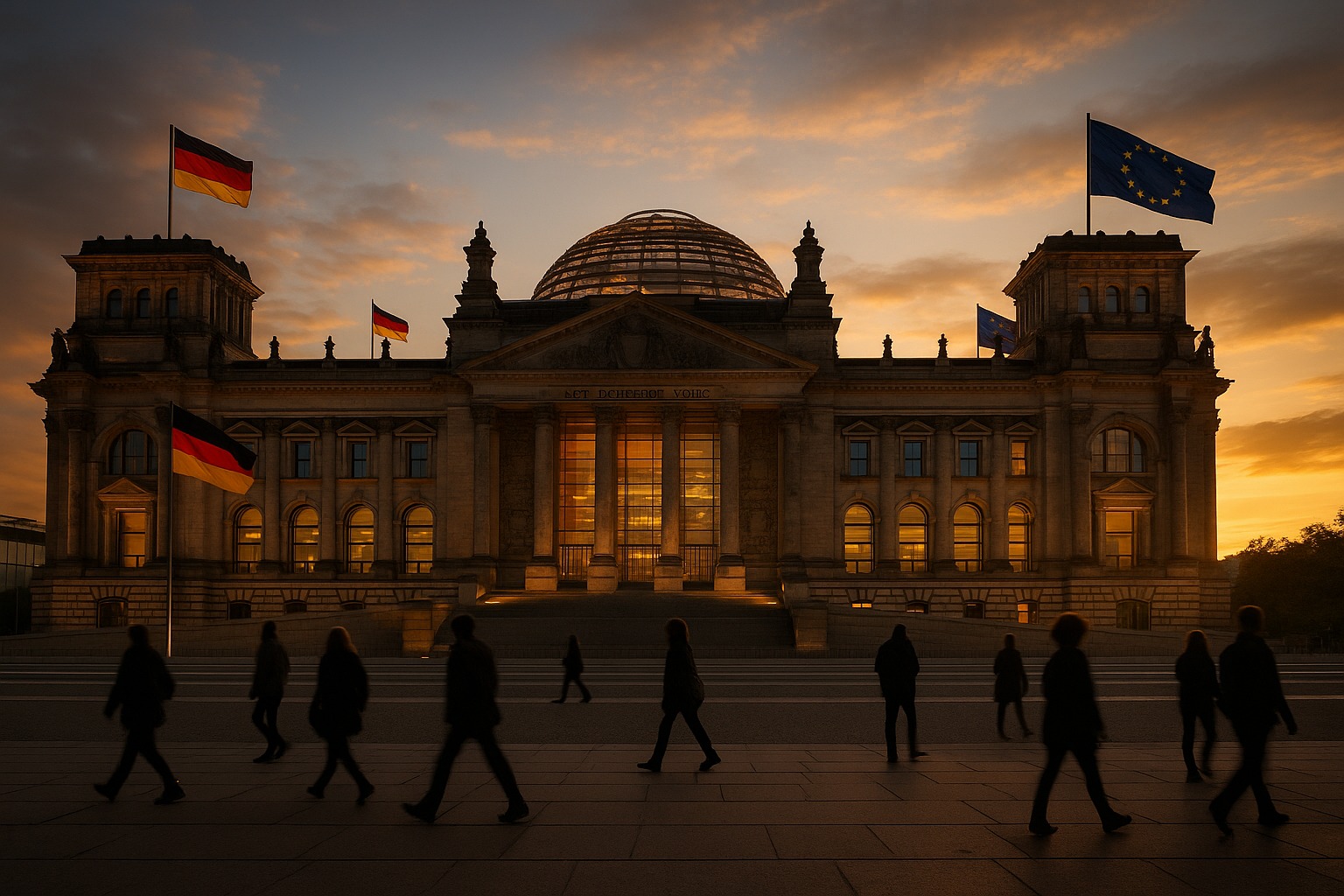
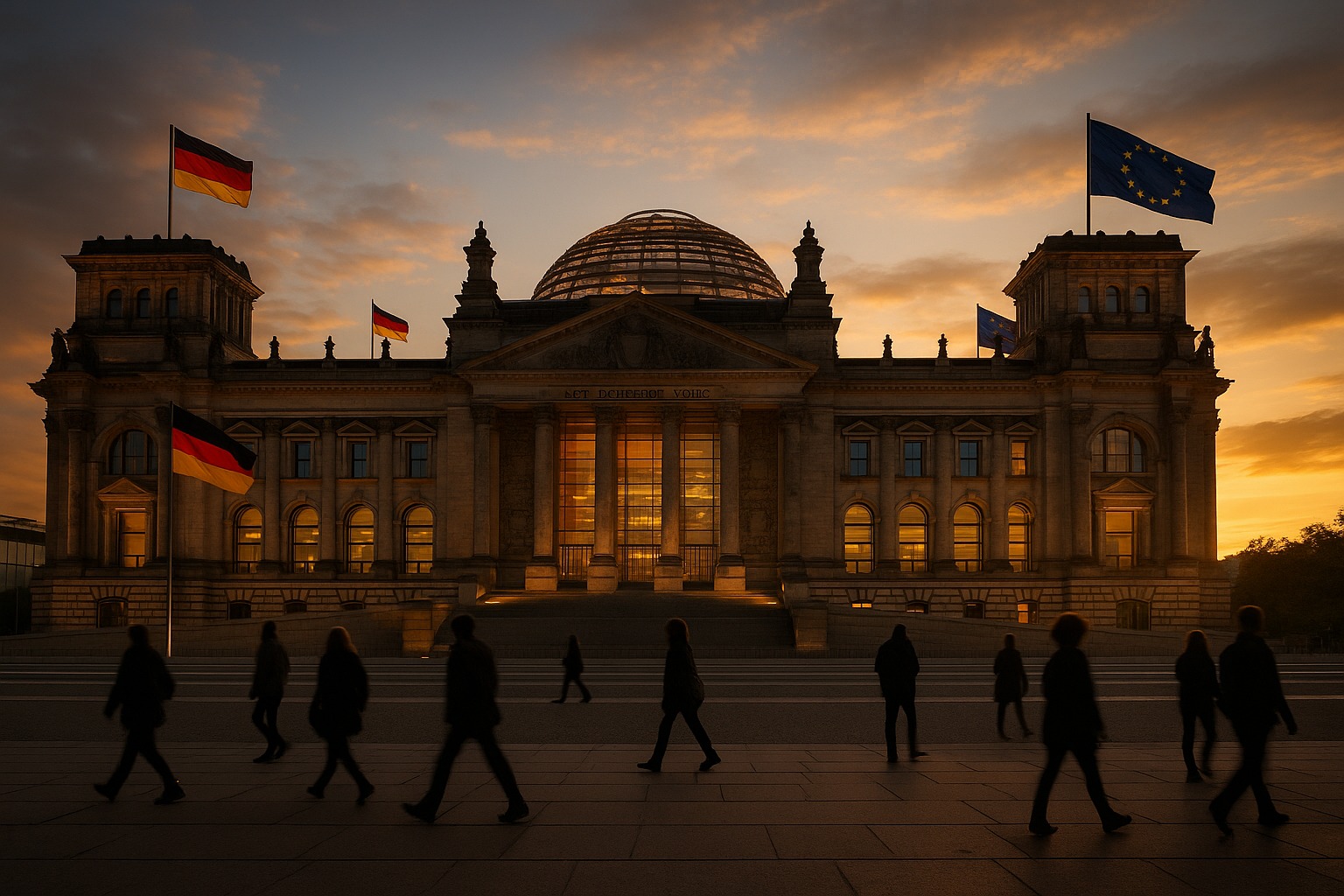
The chancellor and his or her closest staff work in the Federal Chancellery (Bundeskanzleramt) in Berlin. This building is much more than just an office complex – it is the nerve center that coordinates the entire federal government.
The Chancellery is headed by the Head of the Federal Chancellery (Chef des Bundeskanzleramtes), usually a minister or minister of state. This person belongs to the chancellor’s inner circle of trust, oversees coordination among federal ministries, and monitors the implementation of cabinet decisions.
6. Historical snapshots: Chancellors who shaped Germany
Since the founding of the Federal Republic in 1949, several chancellors have left a lasting mark on German and European history:
-
Konrad Adenauer: First chancellor of West Germany; drove the reconstruction, anchored the country firmly in the West, and laid the foundation for European integration.
-
Willy Brandt: Famous for his Ostpolitik, a new approach aimed at improving relations with East Germany and the Eastern Bloc. He was awarded the Nobel Peace Prize for his efforts toward reconciliation.
-
Helmut Schmidt: Guided Germany through difficult economic times and adopted a firm stance against terrorism by the Red Army Faction (RAF).
-
Helmut Kohl: The chancellor of German reunification; under his leadership, East and West Germany were reunited in 1990. With 16 years in office, he is one of the longest-serving chancellors.
-
Gerhard Schröder: Launched far-reaching and controversial economic and social reforms known as “Agenda 2010”, fundamentally transforming the labor market and welfare system.
-
Angela Merkel: The first woman to hold the office; led Germany and Europe through financial crises, the eurozone crisis and the refugee crisis. Over 16 years she became one of the most influential political figures in Europe.
Conclusion: A pivotal role with far-reaching impact
The office of the German Federal Chancellor is far more than a high-ranking administrative post. It sits at the apex of the political power structure, combining broad executive authority with direct accountability to an elected parliament.
Through the power to set political guidelines and lead the federal government, the chancellor plays a decisive role in shaping Germany’s present and future and in determining its position and influence in Europe and the wider world. To understand this office is to understand one of the core pillars of power and stability in one of the world’s most important democracies.
The editorial team of the website strives to provide accurate information based on thorough research and consultation of multiple sources. Nevertheless, errors or uncertainties may occur. The information in this article should therefore be regarded as an initial point of reference. For binding and up-to-date information, please always contact the competent authorities and official bodies.